Freitag, 22. November 2013

Leben wie im Paradies - Wohnen in Bali

Liebe Gäste von Amed Scuba!
Amed Scuba Unterkunft und Garten
 
Traumvilla in Bali ab 45 Euro pro Person
Mit diesem Schreiben möchten wir uns bei all unseren bisherigen Gästen für ihren Aufenthalt bedanken und hoffen sehr, dass es Euch gefallen hat. Wir freuen uns auf ein Wiedersehen. Für die Unterkunft auf Bali können wir Tauchgruppen oder auch Familien oder bei Reisen mit Freunden ein schönes Angebot mit unterbreiten


Ein großes Palmengrundstück an einem beinahe menschenleeren Ufer gelegen. Solche Villen lasen sich auf Bali nicht allzu häufig finden. 


Taucher haben es bei uns sehr bequem, denn wir bieten eine Möglichkeit für individuelles Tauchen in kleinen Gruppen. Tauchen Sie ab mit der deutschen Tauchlehrerin und Meeresbiologin Christine und ihrem Team von Amed Scuba. Wir holen die Taucher direkt aus der Villa ab.
 
Außer sehr viel Ruhe bieten wir Massagen, Kochkurse, Tagesausflüge und Yoga an. Auf Wunsch gestalten wir balinesische Hochzeitzeremonien und andere Familienfeiern.


Bali Villas in Sambirenteng
 
Die Villa Kura Kura ist auf einem 3.200 qm großen Palmengrundstück gelegen und hat eine eigene Uferfront von 40 Metern. Die Villa hat 2 Zimmer und einen extra Bungalow, ein offenes “Wohnzimmer”, eine große überdachte Terrasse und einen Swimmingpool.
 
Villa Melamun grenzt direkt an Kura Kura auf einem 2.300 qm großen Land. Es hat eine Wohn- und Nutzfläche von ca. 500 qm und bietet mit 7 Zimmern bis zu dreizehn Personen ein großzügiges Zuhause.
 
Entfernung zur Liberty 20 Minuten
Da es für einzelne Paare oder eine Familie oft zu groß ist, bieten wir ab Anfang 2014 das Melamun auch getrennt in Villa West und Villa Ost an. Diese beiden gleichwertigen Haushälften mit je 3 Zimmern sind durch eine gemeinsame Lobby verbunden, in der sich die Restauration, eine Bar und der Fernsehbereich befinden.
 
Jedes dieser beiden Hausteile hat einen eigenen Uferpavillon mit Terrasse, eine kleine Getränkeküche, WC, Massageplatz und einen separaten Einstieg in den Pool und ans Ufer.
 
 
Anliegend erhaltet Ihr unsere Preisliste, gültig ab 1. Februar 2014.
 

Die Preise für den West- und den Ostteil der Villa Melamun findet Ihr in anliegender Preisliste.
 
PREISLISTE
gültig ab 1. Februar 2014
 
Folgende Preise verstehen sich in Euro einschließlich Frühstück und 10% Steuer. Ohne Servicecharge.
Kostenloses WiFi in allen  Häusern
Änderungen vorbehalten

VILLA KURA KURA
Sambirenteng/Nordostküste
 
KOMPLETTE VILLA
 
Kura Kura verfügt über 2 Doppelzimmer und
1 Bungalow für 2 Personen.
Mindestbuchung eine Woche.
Optionale Vollverpflegung, Transfer und Aktivitäten   wie Melamun
Folgende Preise verstehen sich für die komplette Villa/Nacht,
einschließlich Frühstück und Steuer.
.
Manta Point auf Nusa Penida kann besichtigt werden

Anzahl
Gäste
Pro
Person
Pro
Zimmer
Komplette
Villa

2
90
180
180

3
70
 
210 

4
60
120
240

5
52
 
260

6
45
90
270


VILLA MELAMUN
Sambirenteng/Nordostküste
 
KOMPLETTE  VILLA 
.
Melamun verfügt über 5 komfortable Doppelzimmer/Bad,
eine Familiensuite/Bad  (*11/12)
und ein kleines Einzelzimmer/Bad  (**13)
Komplettbuchung der gesamten Villa
für mindestens eine Woche.
Einschließlich Frühstück und Steuer
 
VOLLVERPFLEGUNG:
Lunch - Kaffe/Kuchen - Dinner: Komplett: €15,-
Nur Lunch: € 5,-.  Nur Dinner: €10,-
 
FLUGHAFENTRANSFER:
Eine Richtung für bis zu 4 Personen: € 85,-
Größeres Fahrzeug auf Anfrage
 
Massagen - Yoga - Kochkurse - Tagesausflüge
 
Balinesische Hochzeitzeremonien und andere Familienfeiern auf Anfrage
Intakte Korallenriffe in Amed 45 Minuten entfernt


zahl
Gäste
Pro
Person
Pro
Zimmer
Komplette
Villa


Komplette Villa


2
148
296
296


3
106
 
318


4
85
170
340


5
71
 
355


6
63
126
378


7
57
 
399


8
52
104
416


9
48
 
432


10
45
90
450


*  11
42
 
462


12
40
80
480


13
38
 
490


VILLA  WEST- und OSTHÄLFTE
 
Die Villa hat 2 gleichwertige Haushälften, getrennt durch eine gemeinsame Lobby, mit Restauration, Bar und Fernsehbereich (Deutsche Welle).
Jedes Hausteil hat einen eigenen Uferpavillon mit Terrasse, Getränkeküche/Kühlschrank, WC, Massageplatz und separaten  Einstieg
in den Pool und zum Ufer.

Anzahl
Gäste
Pro
Person
Pro
Zimmer
Komplette
Haushälfte
Mit Mola molas taucht man in Bali von Juni bis August

Villa West
Der Westteil der Villa ist im Obergeschoss mit einer Familiensuite mit zwei Doppelzimmern und gemeinsamen Bad eingerichtet. Eins mit Loggia und Seeblick, eins mit Gartenblick.
Erdgeschoss: Doppelzimmer/Bad/Terrasse/Seeblick.
.

2
80
160
160

3
65
 
195 

4
53
106
212 

5
46
 
230 

6
40
80
240 

Villa Ost
Die Osthälfte hat im Obergeschoss zwei Doppelzimmer/Bad, eins mit Loggia und Seeblick,
eins mit Gartenblick.
Erdgeschoss:1 Doppelzimmer/Bad/Terrasse/Seeblick und ein kleines Einzelzimmer/Bad/Gartenblick (**7)
.

2
80
160
160

3
65
 
195 
Für weiter Fragen stehen wir Ihnen gerne zur Verfügung!
Sie erreichen uns über unsere Amed Scuba e-mail adresse halloscuba@yahoo.com
Telefonisch über +62 81 999 123 847
oder auf der Boot in Düsseldorf
Wir freuen uns auf Euren Besuch!

Herzliche Grüße aus Bali
Christine von Amed Scuba
Amed Scuba auf der Boot in Düsseldorf


4
53
106
 

Reef Ecology

Video is made by Astrid King-Kaupp and Stefan Kaupp

 
Diving over a tropical coral reef has been compared to stepping into a time machine. Watching the video you find yourself in a strange place, ten million years out of synch with the land.
coral garden in Bali - Amed Scuba Diving tours
The reef is a reminder of a time when all the life on earth existed in shallow, tropical seas. This was the the original soup of creation!
Nowhere else is there such a diversity of animals. The myriad fish, vertebrata and invertebrata that shelter among and encrust the rugged surfaces provided by the clups, shelves and branches of coral are overwhelming in their numbers, shapes and colors. The waters surrounding the islands of Indonesia form the richest marine habitat on earth. Indonesia lies at the epicenter of species diversity for the entire tropical Indo-Pacific region. Perhaps 3000 species of fish, and several hundred species of coral populate the reefs off the larger Indonesian islands. Nowhere else you will find such a diversity of animal forms. The islands that now make up Indonesia are likely to have been the genetic source of marine life. This region has remained tropical for 100 million years, exposed
The presence of large gorgonians, crinoids and schools of planktivores like this anthias indicates plankton-rich waters, which can provide a spectacular concertration of marine life. Bali Amed coral garden

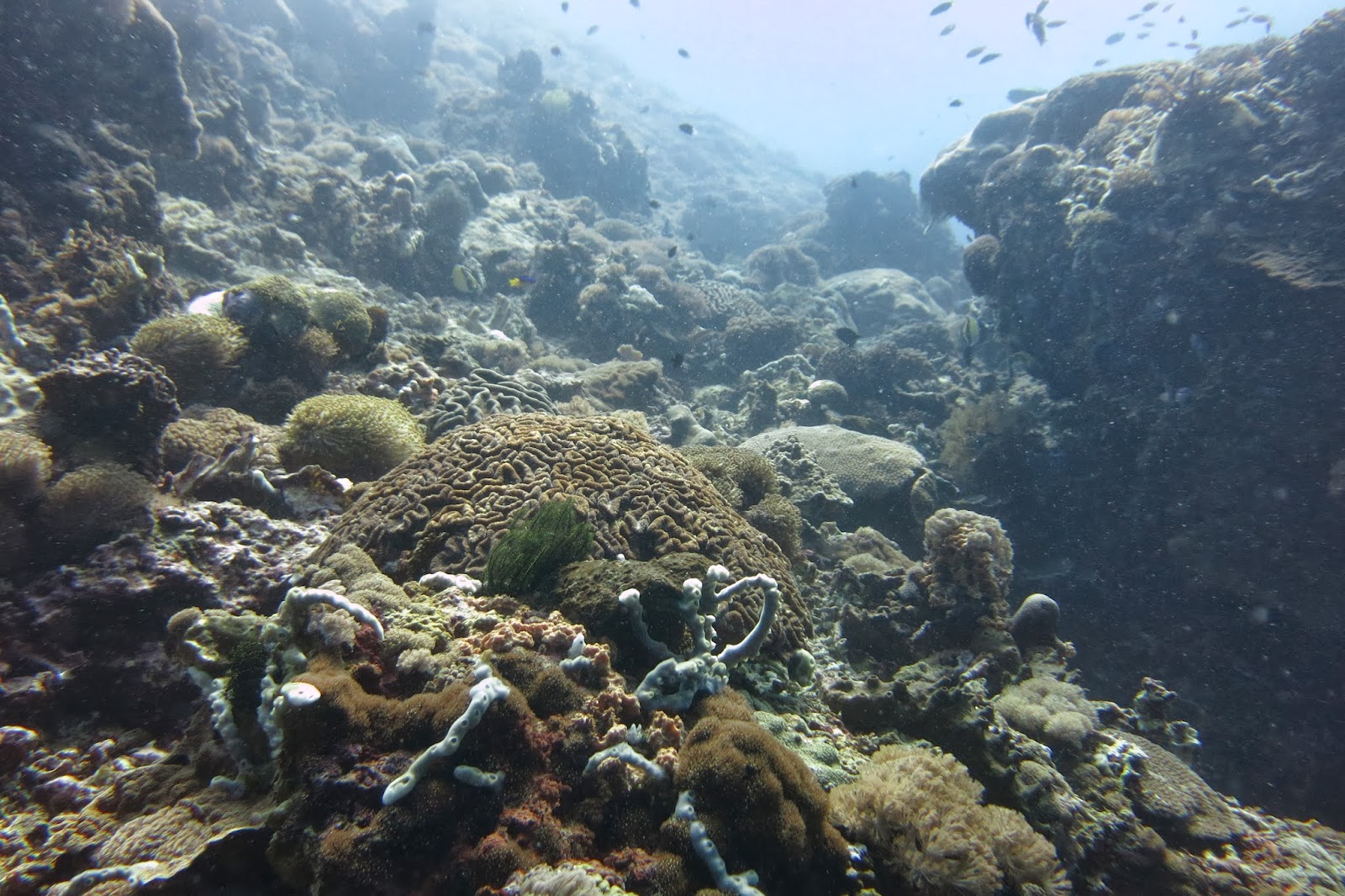
Crystal clear tropical water is nutrient poor, an aquaticdesert. The strange and varied forms of the members of coral reef communities allow each to fill a niche in a complex nutrient cycle.
to the strong sunlight that makes tropical waters so much richer than temperate waters, giving the animals a long time to diversify.
There are so many species present on the Indonesian reefs that even specialists can not give an exact tally of their numbers here.
Crystal clear tropical water is nutrient poor, an aquatic desert! The strange and varied forms of the members of coral reef communities allow each to fill a niche in a complex nutrient cycle, beginning with the fixing of nutrients by the photosynthesis of the zooxantella of the corals, of algae and working up to the reef shark that snatches an aging fish from the school. The ammonia and feces secreted by the predator are cycled right back into the reef ecosystem. Therefor it is not recommended to take anything out of this nutrient poor water!
Over half a billion years, when the first simple coral reefs first formed, this community hs made a remarkable geological impact.The stony coral skeletons become overgrown and compacted into rock, eventually building up a prodigious thickness of limestone.When forced upward by the buckling of the earth´s crust, this old reef rock forms islands.

Donnerstag, 21. November 2013

North of Bali

Diving in the north of Bali
Beautiful Bay of Jemeluk

Bali has more tourist services than anywhere else in Indonesia. It is a beautiful island and the diving is excellent. There are many different diving sites here from the steep walls of the island Menjangan in the Bali Barat National Park to the area of Amed and Tulamben in the north - east of Bali to the currents
Beach of Amed
and cold water of Nusa Penida in the south - east with Mantas and Mola molas.
The north east coast is the driest part of Bali. The visibility is usually very good and the fish and coral life is excellent. Therefore the corals are growing in crystal clear water. Divers on a tight schedule could dive Jemeluk in the morning and the Tulamben wreck - just a few kilometers away- in the afternoon. But both areas offers more than 20 different excellent dive spots. The area of Amed offers the best variety of fish life and coral formation we have seen in all of Bali. Amed is just off Bali´s main east coast highway. Comming up from the south the hghway pases through Klungkung, Candi Dasa, Amlapura and Culik. Just 10 km before Tulamben, a paved side road from the little town of Culik drops directly to the coast at Amed, 3 kilometers away. From Amed , the paved road turns right and passes a long stretch of traditional salt works. Two kilometers from Amed you are in Jemeluk, a fairly small bay with a beach of black, vulcanic sand, crowded with about a hundred colorful jukung, local outrigger fishing canoes powered by sails or small outboards.
Actually Amed is a little fishing village in the northeast of Bali. It is not only one village it is more a coastline with several bays. The people there are very friendly and polied. It is a good place to go for scuba diving. Above and below the water there are many things to discover. The water palaces Tirtaganga and Ujung where you can see different cultural Hindu ceremonies. Or you can climb up one of the main temples of Bali - Lampujang. Up in the mountains you have a wounderfull view over rice padies and down to the sea. The diving is fantastic! Try all the different diving sites which offers drift dives, muck diving, slopes and dropoffs, wrecks and artificial coral gardens. I organise my trip with the wounderfull people of amed scuba. All the time friendly, joking and helpfull in any way. amedscuba.com I will come back because I fall in love with this little village and the people of Amed.
The landscape is dominated by the Gunung Agung
Corals have not a huge tolerance against fresh water influences and here the amount of salt is stabil. A great environment to let the corals grow until the surface. The difference with the green south is amazing. The landscape is dominated by the Gunung Agung, Mount Batur and Gunung Catur.
First you reach Amed, a small fishing village with a very long and varied shoreline, decorated with many secluded bays. A good ite for snorkeling and diving directly from the shore, with a steep coral wall, with wreck dives, drift dives and collourful coral gardens. Here you can spot magical coral gardens, crabs, cuttle fish, octopus, turtles, lots of different species of nudibranches, ghostpipefish, pygmy seahorses, seahorses, sharks and sometimes Mola molas or treasure sharks in Gili Selang. The variety of different diving sites and possibilities are amazing!
Turtles are quite common in Amed

Gili Selang
Coral Garden in Gili Selang

Reef type: Coastal reef; flats, slope
Access: 5 minutes by small boat
Visibility: Fair to good, 20-30 meters
Current: around the island, surge inside the coral garden
Coral: The best you might have ever seen, best hart and soft coral variety in Bali
Fish: Exellent numbers, superb variety of small reef fishes, fish schools and big fish around the island
Highlight: Density of fish, amazing coral formations, collours and shape of soft and hart corals.
We approach Gili Selang by a local fishing boat called Jukung. Diving with local fisher man means also to support the local infrastructure and let the fisherman know how lovely is this diving experience and give them some income from the dive industrie and the tourism. Gili Selang is a small island right at the most eastern point of Bali. This dive site is beautiful for its location and its hart and soft corals but fierce currents make it quite tricky for the diver. Gili Selang is for me one of the most beautiful dive sites in Bali and in the world! But it is not possible to dive here as beginner because you will find a strong rotate up- and down current like in a washing machine. And this dive is also only possible if the conditions are good here! The small island Gili Selang is divided from Bali through an only five meter deep channel. North of the island is a shallow lagoon where we start our dive. Here you will find a marine life which is virtually untouched. This underwater world offers a rich array of fish and hard and soft coral which you see nowhere else. The lagoon is only 18 meters deep and you will notice similar no current. If you leave the lagoon to dive around the island you find a wall falling down in the deep blue. Sometimes you will find here a very strong up and down current. You should be an experienced diver to stand this washing machine! With a little luck you can see here hammerhead sharks as well.We have to check the tide and the conditions carefully before we dive this spot. It offers reward with its huge under water rocks covered with magical colourful hart- and soft coral and surrounded by all kinds of fish, eagle rays, turtles, millions of colourful fishes, octopus, cuttle fishes, reef sharks, hammerhead sharkes and treasure sharks. One of the most beautiful diving sites here in Bali or maybe the most beautiful... The coralgardens are still untouched.

Kusambi
Clouds of fishes in the coral garden of Kusambi

Hexacoralia in Kusambi
If you want to see Mola molas here in Amed - Kusambi is the place to go! Only recommended for experienced divers! We approach Kusambi by a local fishing boat called Jukung. We start in a safe bay, dive down to a small wall and follow the current along the coral garden. Kusambi is special for its spectacular hart and soft corals but has usually quite a strong current. The fishing boat will follow the divers! It is worth the effort because the dive in Kusambi is very special indeed. Mola molas in deep water, reef sharks, sting rays, eagle rays and millions of reef fishes inhabit this area as well as gorgonians, sponges and feather stars. Huge coral blocks surrounded from colourful coral gardens sometimes with cold currents in a termocline give this invironment a lots of nutrigens to grow in amazing forms. You will never forget this diving site when you dive in Gili Selang or in Kusambi. 

Blue Lagoon

With a local outrigger boat we reach the beautiful drift diving site Blue Moon. Because of the current we will drift through a soup of fish. Millions of Anthias are floating over steakhorn coral fields. Bigger schools of fish can be spotted here and sometimes a hunter like baraccudas go shoping here. A beautiful schenery with under water canyans can be seen here with sponges in all sizes and hart- and soft corals in all shapes and colours. Sharks are hunting here as well as large moray eels. Huge Napoleons, sting rays and even occasionally bullrays appear in this area. The 5m stop is gorgeous being surrounded by thousands of little, colorful reef fishes.

Japanese Wreck

Japanese Wreck in Banjuning with Amed Scuba
South of Amed in a little bay of the village Banjuning you will find a small steel and wooden shipwreck. We don’t know anything about the history of this wreck but we can highly recommend diving this site.
The freighter lies in shallow water from 3 until 15 meters. The rather small (about 10 meter long) ship wreck is lying just a few meters from the shore on a depth of just a few
Steakhorncorale field in Japanese wreck
meters in a beautiful coral garden and is therefore also a perfect spot for snorkeling.
It is wonderful encrusted with colourful christmas trees, soft corals, gorgonians and black corals. You will see lots of big and small reef fish which have found a home inside the freighter. The rich variety of colourful species makes this dive site so special. Also the area around the boat is rich of species like nudibranch, lobster, barracuda, tuna and lots of colourful reef fishes. Because we will find always a little current in this place a boat will follow the divers and pick them up at the end of the dive. This dive site is also recommended for beginners. But it is also possible to go there by car and dive straight from the beach.  Divers usually go around the corner and dive deeper to about 25m with a fair chance to encounter an eagle ray or two. Napoleon fish, turtles, striped catfish, sting rays, sea fan and nudibranches can bee seen at the Japanese ship wreck.

Jemeluk

Reef type: Coastal reef, flats, slope and wall
Access: Beach, 5 minutes by small boat
Visbility: Fair to good, 10-20 meters
Current: Mild
Coral: Excellent
Fish: superb variety
Highlights: huge sponges, density of fish schools

Jemeluk offers excellent dive sites for training dives and shows all the beauty for experienced divers as well. The magnificent reef of Jemeluk which covers the total wide of the beach grounds starts directly in front of our dive school. If you enter the crystal-clear water you find a flat bottom lagoon for instruction and a drop-off, only a five minute swim away. The reef of Jemeluk curves around a rock outcropping just east of town. At around eight meters you come down on an extensive spread of staghorn Acropora teeming with damselfishes and cardinalfishes. A short slope led to a coral wall, where we dropped to 43 meters, hanging there about 8-10 meters above the sandy bottom. The wall is magic! This area can be highly recommended for introductory dives at the sandy bottom and in the shallow coral garden. And even if you are an experienced diver you will find along the wall always something new on each dive, no matter how many times you will dive here. It is a spectacular site for night dives as well. Schools of fish of several species cascaded down the wall or took the electric stairs back up in orderly, two, way traffic. The schools include black triggerfish, lots of bannerfish, black snappers, humpback snappers, pyramid butterfies, and countless others. Further off from the wall, the usual school of yellowfail fusiliers kept an eye on proceedings.  
The wall falls down until app. 45 meters and it is covered with a variety of colourful hard and soft corals. You will see 3 meter gorgonian fans which are open in the smooth current to take there dinner and huge sponges with jumping craps and shrimps. There is a splendid diversity of big and small tropical fishes which include for example angelfish, batfish, barracuda, butterflyfish, napoleonfish, lionfish, parrotfish and Bumphead Parrotfish as well. Octopus shows us there talent to change there colour and we will see colourful nudibranch like Chromodoris and Phyllidia species. With a little luck you will discover Spanish Dancers and the Pink Nudibranch. This dive is recommended for all level of divers. You will dive against a very smooth currant in a dept of app. 20 meters along the wall and you come back with the current in shallower water to the point where you have been started.


Melasti
Harlequin Shrimp in Melasti

From the beach we simply walk into the water and dive Amed Scuba Bali Diving Center in Melasti, where you can see our rare species like the harlequin shrimps, clown frog fish, different kinds of ghost pipe fish and nudibranches, mimic octopuses, huge stone fishes, amazing crabs, tiny juvenile lion fishes, seahorse, razor fish, just to mention a few, can be found Melasti. Photographers from all over the world come here to take pictures of these rarely found species. Visit Bali, come to Amed and check it out.

Freitag, 8. November 2013

Blumentiere, Anthozoa Korallen

Korallengarten in Nusa Penida
Korallengarten in Menjangan - Amed Scuba Diving Tour
Es gibt Dinge um uns, die wir oft nicht nicht richtig wahrnehmen können, die jedoch überlebenswichtig für uns sind. Dazu gehört zum Beispiel das Sonnenlicht! Wir nehmen seine Anwesenheit wahr, aber wir können seine 'Energie', aus der das Sonnelicht besteht, nicht immer spüren. Wir spüren seine Wärme auf unserem Körper, aber nutzen können wir diese Energie nicht. Dazu sind nur photoautotrophe Organismen in der Lage, die mit Hilfe von Sonnenlicht und Wasser das für uns so lebenwichtige Sauerstoff produzieren und ihre eigene Energie in Form von Zucker. Dadurch sind diese Organismen von der Existenz der im Sonnelicht gespeicherten Energie abhängig, und gehen ohne diese zugrunde. Jedoch auch ein Zuviel an dieser Energie kann schaden! Daher schützen sich Korallen auch mit einem körpereigenem Sonnenschutz mit sehr hohem Lichtschutzfaktor und dürfen daher auf gar keinen Fall angefasst werden. Obwohl lebende Korallenpolypen fast einer Blume ähneln, handelt es sich bei einer Koralle nicht um eine Pflanze sondern um ein Tier. Wie kann sie dann photoautotrph sein und sich von Zucker aus der Photosynthese ernähren? Das macht sie nicht! Die Koralle ist ein Tier. Aber innerhalb dieses Tieres lebt eine winzige Alge Zooxantehella genannt. Ausgesprochen "Zo-o-xan-thel-la", das Wort kommt aus dem griechischen und besteht aus "Zoion" (Tier) und "Xanthos" (gelb) und "-Ella" als eine Verkleinerungsform. Und das "kleine gelbe etwas, was in lebenden Tieren lebt" liefert die Grundstoffe und ist somit neben der in enger Symbiose lebenden Koralle der wichtigste Treiber des Lebens in einem Riff-System! Gleichzeitig gibt diese winzige Alge der Koralle seine wunderbare Farbe, denn diese kommt meistens nicht vom Polypen selbst.
Die Klasse der Anthozoen oder auch Blumentiere genannt, bilden mit 7500 Arten die größte Klasse des Stammes der Nesseltiere Cnidaria

Korallengarten in Menjangan - Amed Scuba Diving Tour
Blumentiere leben entweder alleine (solitär) oder  sie sind stockbildend und leben in großen Kollonien. In Abgrenzung zu den Quallen tritt in dieser Klasse keine Medusenform auf.
Blumentiere sind an Wasser gebunden und weltweit in allen Meeren verbreitet. Sie sind bis in eine Tiefe von 6.000 m anzutreffen. Einzellebende Exemplare sind an harte Oberfläche gebunden oder tief im Schlamm oder Sand vergraben. Koloniebildende Blumentiere hingegen überkrusten andere Substrate oder bilden Skelette unterschiedlichster Formen aus.Riffbildende Arten leben typischerweise in flachen (bis 40m Tiefe), klaren, tropischen Gewässern.
Korallenpolypen haben einen charakteristischen Bau: der Gastralraum (Verdauungstrakt) ist durch Trennwände (Septen, Mesenterien, Sarcosepten, Mesenterien) in Gastraltaschen unterteilt, die oral an einem nach innen ragenden, schlitzförmigen Mundrohr enden. Im Mundrohr schlagen 1–2 Wimperstraßen (Syphonoglype), die zusammen mit den Flimmerepithelien der Mesenterien stets einen Wasserstrom durch den Polypen erzeugen und dadurch der Exkretion und Atmung dienen. Beute wird mit den Tentakeln gefangen, dem Mund zugeführt und anschließend in den Gastraltaschen verdaut. Dabei spielen die gekräuselten, frei beweglichen Ränder der Mesenterien (Mesentärfilamente)
Weich- und Hartkorallenformationen in Menjangan Amed Scuba Diving Tour
als Produzenten der Verdauungsenzyme eine wichtige Rolle. Die Anordnung der entodermal gebildeten Muskeln an den Septen ist bilateralsymmetrisch. Zwischen Längsmuskelpaket und Mesenterialfilament liegen jeweils in der Mesogloea des Septums die Geschlechtszellen. Sie gelangen bei der Reife in den Gastralraum und von dort nach außen. Bei manchen Arten findet im Gastralraum Brutpflege statt. Neben geschlechtlicher ist ungeschlechtliche Fortpflanzng durch Knospung häufig. Viele Anthozoen sind skelettbildend und tragen zur Korallenriffbildung bei. Nach der Ausbildung von 8 oder 6 (als Basiszahl) Septen oder Mesentereine unterscheidet man die beiden Unterklassen Hexacorallia und Octocorallia.
Mesenterien (Scheidewände im Inneren des Polypen) unterteilen den Gastralraum eines Korallenpolypen in Kammern. Sie verleiht stabilität. Der Gastralraum des Polypen ist sowohl der Magen als auch der Darmtrakt. Der Eingang ist sowohl Mund als auch After. Er dient in erster Linie der Verdauung und der Verteilung der Nährstoffe. Nach der Ausbildung von 8 oder 6 (als Basiszahl) Scheidewände unterscheidet man die beiden Unterklassen Hexacorallia und Octocorallia.

Weichkoralle

Octocorallia sind eine Unterklasse der Blumentiere. Sie besitzen 8 meist gefiederte Tentakeln und haben 8
Octocorallia
Mesenterien (Längswände) ausgebildet, die den Gastralraum in acht Kammern unterteilen. Die Polypen der Octocorallia sind sehr einheitlich gebaut, Der Gastralraum reicht aufwärts in die hohlen Tentakel.Am Aufbau der Korallenriffe sind diese Weichkorallen jedoch nicht beteiligt, da sie kein stabiles Skelet besitzen.
Das Skelett der Octocorallia leitet sich von kalzitischen Skleriten ab, die miteinander verwachsen und auf diese Weise feste Gerüste bilden. Die einzige Ausnahme sind hier die Helioporida, deren Skelet aus Argonitfastern besteht.
Im Deutschen werden taxonomisch jedoch falsch verschiedene Gruppen nach Wuchsform und Festigkeit eingeteilt. Man unterscheidet Weich- (Alcyonacea), Röhren- (Stolonifera), Leder- (Alcyoniideae) und Hornkorallen von Gorgonien (Gorgonacea), Seefächer oder Seefedern (Pennatulacea).
Abiotische Faktoren spielen eine große Rolle beim Riffwachstum, an dem jedoch keine Weichkorallen beteiligt sind, sondern nur ihren Platz innerhalb des Riffes finden.
Tauchen und Forschen mit Amed Scuba Bali

Standortfaktoren
Abiotische Faktoren begrenzen Korallenriffe auf bestimmte Regionen unserer Erde, da sie das Riffwachstum limitieren. Zu diesen Faktoren gehören die Temperatur, die Lichtverhältnisse und die Salinität des Meeres.

Temperatur
Die Wachstumsstandorte der Korallenriffe weisen relativ gleich bleibende Bedingungen auf, die sich zum großen Teil im Bereich der 20°-Isotherme abspielen. Optimale Wachstumsbedingungen finden Korallenriffe bei durchschnittlichen Wassertemperaturen von 25 bis 26°Celsius vor. Fallen die Temperaturen unter 20°Celsius so sinkt zunächst die Wachstumsrate der riffbildenden Korallen. Fallen die Temperaturen jedoch weiter, so sterben die Korallen. Bei einer Wassertemperatur von 15°C geschieht dies bereits nach 24 Stunden und alle Korallen sind tot.
Bei ansteigenden Temperaturen über 29°Celsius kommt es durch den Stressfaktor dem die Korallen dadurch ausgesetzt sind zur so genannten Korallenbleiche. Die Alge, die in der Koralle lebt, produziert falsche Stoffwechselprodukte und wird von ihrem Wirten abgestoßen. Diese obligate Endosymbiose zwischen Koralle und seiner Zooxanthellen ist lebensnotwendig für das Überleben des Riffes. Kehrt der Symbiont nicht innerhalb eines halben Jahres zu seinem Wirten zurück, so sterben die Korallenpolypen.

Lichtverhältnisse
Amed Scuba, Gili Selang

Licht ist der begrenzende Faktor bei der Verbreitung des Riffes in tieferes Wasser. In Tiefen von 70 bis 90m können Korallen kaum noch wachsen. Die Lichtintensität liegt hier unter 10% im Vergleich zur Oberfläche. Die Abhängigkeit des Korallenwachstums vom Licht rührt von der symbiotischen Beziehung zwischen Korallen und den Algen her. Die autotrophen Zooxanthellen benötigen das Sonnenlicht für ihre Photosynthese, um mit Hilfe des Lichtes aus Wasser und Kohlendioxid Zucker und Sauerstoff zu gewinnen. Der Zucker ernährt sowohl die Algen als auch die Korallenpolypen.
Aber der Lichtgradient im Riff ändert sich nicht nur von oben nach unten, sondern auch innerhalb des Riffes entstehen durch das unterschiedliche Wachstum der Korallen selbst vielfältige Licht-Schatten Bereiche. Um sich an diese Lichtverhältnisse anzupassen, wachsen die Korallen in verschiedenen Bereichen unterschiedlich gut. Dadurch differenziert sich das Riff in ökologisch unterschiedliche Bereiche und es entstehen unterschiedliche ökologische Nischen.
Neben dem physikalischen Raum, den ein Organismus besetzt, beschreibt die ökologische Nische auch das spezifische Wirkungsfeld einer Art, die durch ein System von Wechselbeziehungen zwischen dem Organismus und seiner Umwelt entsteht.

Salinität
Optimale Wachstumsbedingungen finden die riffbauenden Organismen bei einem durchschnittlichen Salzgehalt im Sommer von 36 Promille und im Spätsommer von 28 bis 32 Promille vor. Dabei werden höhere Salzgehalte bis maximal 45 Promille leichter akzeptiert als zu niedrige. Das stellt ein Problem in der Regenzeit dar und durch eventuelle Einleitungen von Süßwasser durch eine wachsende Anzahl von Hotels an der Küstenlinie. Obwohl Korallen kurzzeitig einen niedrigeren Salzgehalt bis zu 75% unter dem Normalwert tolerieren, sterben sie nach kurzer Einwirkungszeit ab. Daher findet man auch keine Koralleriffe im Einflussbereich von Süßwasser wie zum Beispiel in Flussmündungen.
Amed Scuba Korallen wachsen ineinander und konkurieren um Raum

Als limitierend für das Riffwachstum erweisen sich vor allem PO4-P und NH4, die im oligotrophen Riff sogar über dem Wert des Riff umspülenden Wassers liegt. Die Konzentration von PO4-P ist im Riff gewöhnlich nur geringfügig höher als im umgebenden Ozean. Sie liegt jedoch nahe am limitierenden Faktor für das Phytoplanktonwachstum.
Die NH4 Konzentration liegt gewöhnlich höher als im umgebenden Ozean und über der für das Phytoplankton limitierenden Konzentration.
Aus diesem Grund zeigen sich die Riffe auch ausgesprochen nährstoff- und phytoplanktonarm. Das autotrophe Phytoplankton wird als Primärproduzent jedoch für die Nahrungskette in jedem ökologischen System benötigt, um die folgenden Kettenmitglieder zu ernähren. Energie geht in der Nahrungspyramide unter anderem durch die Stoffwechselreaktionen der lebenden Organismen verloren. Aus diesem Grund ist die enge Endosymbiose zwischen Koralle und Algen unerlässlich für das überleben der Korallen. Die Höhe der autotrophen Primärproduktion hängt jedoch nicht absolut vom Vorrat an anorganischen Nährstoffen im Korallengarten ab, denn das System ist auch mit dem umfließenden Meerwasser verbunden.
Es gibt eine große Menge an unterschiedlichen Korallen, die der Taucher in Bali in den Korallengärten entdecken kann. Eine Kleine Auswahl soll hier folgen:
Pilzkoralle (Fungiidae), Amed Scuba Jemeluk Bay

Pilzkorallen (Fungiidae) sind Steinkorallen, die nicht wie die anderen Arten festgewachsene, in Kolonien lebende Tiere, sondern große Einzelpolypen sind. Sie leben nur in ihrer Jugend auf einem kleinen Stiel sessil. Der Stiel bricht nach einiger Zeit ab und der Einzelpolyp lebt frei in flachem Wasser, auf sandigem Untergrund. Da sie in diesem, für Korallen ungewöhnlichen Lebensraum, leicht von Wellen, Strömung oder Tieren umgedreht, von Sand bedeckt oder beschädigt werden können haben sie ein hohes Regenerationsvermögen und können sich selbst von Sand befreien. Bei zerbrochenen Polypen kann aus jedem Teil ein neuer Polyp wachsen. Die Korallen können sich auch vermehren, indem sie an ihrer Seite Tochterpolypen bilden und abschnüren. Die meisten der 25 Arten der Gattung Fungia erreichen die Größe eines kleinen Tellers. Cycloseris hat nur einen Durchmesser von vier Zentimeter, während die länglichen Herpolitha einen halben Meter lang werden können. Die Korallen kommen in allen warmen Weltmeeren vor.